
Analysis of options for final disposal Possible final disposal options were examined and assessed in terms of their requirements, advantages and disadvantages, as well as their opportunities and risks.
The Radiation Protection Act 2020 sets out the objective of protecting individuals, including their descendants, and the environment from the dangers posed by ionising radiation. This also applies to the final disposal of radioactive waste, which is generated in small quantities in Austria and is classified as low- and intermediate-level radioactive waste.
For short-lived low- and intermediate-level radioactive (LILW-SL) waste, an isolation period of 300 to 500 years is recommended, whilst for long-lived low- and intermediate-level radioactive (LILW-LL) waste, safe confinement for several thousand years must be provided for.
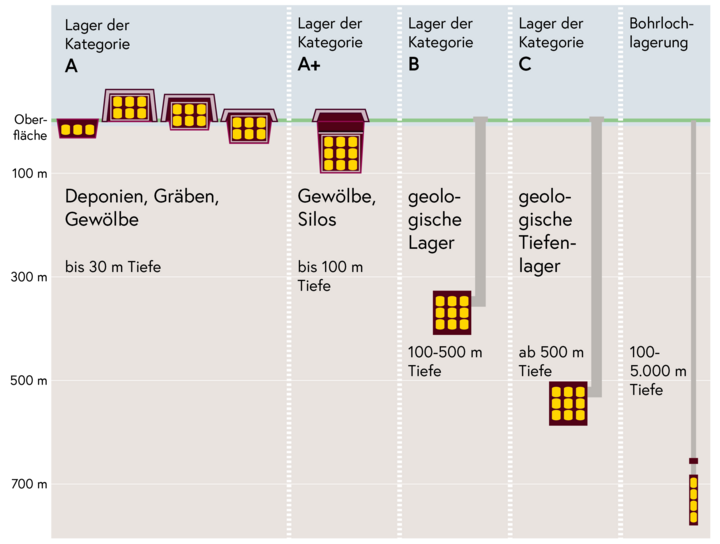
The Waste Management Advisory Board has agreed on the following classification of final disposal categories:
Category A repositories refer to surface repositories and near-surface repositories up to a depth of 30 metres. These include trenches and vaults, enclosed by various barriers. This type of repository is suitable for LILW-SL.
Category A+ repositories are near-surface repositories and refer to vaults and silos at depths of up to approximately 100 metres. Due to the layered filling process and taking into account additional safety measures, the disposal of LILW-LL is possible.
Category B repositories refer to medium-depth geological repositories at depths of approximately 100 to 500 metres. Due to the isolation over extended periods, the disposal of LILW-LL is possible.
Category C repositories are deep geological repositories in stable geological formations at depths of 500 metres or more. These are primarily intended for the disposal of high-level radioactive waste and spent fuel elements.
Borehole disposal refers to the disposal of radioactive waste in lined boreholes at depths of 100 to 500 metres. The boreholes have a small diameter and are therefore suitable for smaller volumes of waste. Borehole disposal is suitable for LILW-LL provided the appropriate depth is achieved. As with the other options, further research and development is still required for the borehole option.
Options for final disposal
Disposal of LILW-SL in Austria at a Category A repository and seeking a bilateral or international solution for the final disposal of LILW-LL abroad.
Disposal of LILW-SL in Austria in a Category A repository and disposal of LILW-LL using a borehole solution.
Joint disposal of LILW-SL and LILW-LL in Austria in a Category B or Category A+ repository.
Security and the legal framework
The safe final disposal of radioactive waste requires both high safety standards and a clear legal framework. The Advisory Committee on Waste Management recommends that safety criteria be established on the basis of internationally recognised standards in order to ensure the long-term protection of people and the environment from the effects of ionising radiation. Furthermore, a dedicated Final Disposal Act should lay the legal foundations for final disposal and guarantee a clear, transparent and traceable procedure.
Recommendations of the Waste Management Advisory Board
2.1 Safety criteria for a final repository – radiological aspects
Observation: Defining the safety criteria for the final repository is an important step that will have an impact on the safety level of the repository and the protection of people and the environment for centuries to come and beyond. Both the choice of repository type and the costs of construction and operation can be significantly influenced by the safety criteria.
Recommendation: The precautionary principle should be made the guiding principle for the safety criteria. The radiological safety criteria for the final repository should be based on the highest international standards. For long-term storage in disposal facilities abroad, only those that meet Austrian standards in any case should be considered.
2.2 Safety objectives for a final repository
Observation: The Radiation Protection Act 2020 states that its objective is to protect individuals, including their descendants, and the environment with a view to ensuring the long-term protection of human health against the dangers posed by ionising radiation. However, Austrian radioactive waste may pose a risk not only through ionising radiation but also through its chemotoxic properties.
Recommendation: A future law on final disposal should be given a comprehensive protection objective that goes beyond the radiological protection objective, so that the negative effects of waste disposal
a) on humans and biodiversity, including animals, plants and their habitats
b) on land and soil, water, air and the climate
(c) on the landscape
d) on property and cultural heritage, and all associated risks, are avoided or minimised as far as possible.
2.3 Options for final disposal
Observation: The discussion within the Waste Management Advisory Board has identified the following options that are feasible for Austrian radioactive waste, each of which has its own specific advantages and disadvantages:
Table 1: Advantages and disadvantages of the final disposal options
Option | Advantages | Disadvantages |
|---|---|---|
a.) LILW-SL: Category A repository and LILW-LL: bilateral/international solution abroad | Lower costs Lower geological requirements Faster process and construction | Export is politically sensitive Higher risk of export failure Greater uncertainty regarding the overall solution |
b.) LILW-SL: Category A storage facility and LILW-LL: borehole solution | Lower costs Lower geological requirements Faster process and construction | Technical feasibility of disposal in a borehole has not been extensively tested Greater uncertainty regarding the overall solution |
c.) LILW-SL and LILW-LL jointly in Category B or Category A+ repositories | Implementation can begin immediately Higher safety level for LILW-SL and LL and waste that cannot be fully characterised chemically, with potentially hazardous chemical properties | Higher costs More difficult site selection Longer construction and storage times for all radioactive waste |
Recommendation: One of the options listed should be implemented following review:
Option a.) Disposal of LILW-SL in Austria in a Category A repository; seeking a bilateral or international solution for the final disposal of LILW-LL abroad.
Option b.) Disposal of LILW-SL in Austria in a Category A repository; disposal of LILW-LL using a borehole solution.
Option c.) Joint disposal of LILW-SL and LILW-LL in Austria in a Category B or Category A+ repository.
2.4 International cooperation
Observation: International collaborations on issues relating to final disposal, such as the ERDO Association, provide a platform for the exchange and acquisition of knowledge. Through Austria’s participation in the ERDO Association or other organisations and research programmes, Austria’s interests can be represented and specific issues and priorities can be promoted accordingly.
Recommendation: Regardless of the final disposal solution chosen, international cooperation and the exchange of knowledge are essential. Participation in international collaborations should be sought.
2.5 The Final Repository Act
Observation: The legal provisions relating to final disposal are not currently adequately covered by the Radiation Protection Act 2020. New provisions are required concerning the safety of the final repository, the site selection procedure and public participation processes, as well as the definition of responsibilities (Final Repository Act).
Recommendation: A Final Repository Act should be enacted as the legal basis for the specific requirements and to ensure a clear, binding and predictable procedure (including safety standards, public participation and decision-making processes) for the final disposal of Austrian radioactive waste. Societal and scientific site selection criteria, which serve as exclusion and weighting criteria, should be enshrined on an equal footing in the new Final Repository Act.