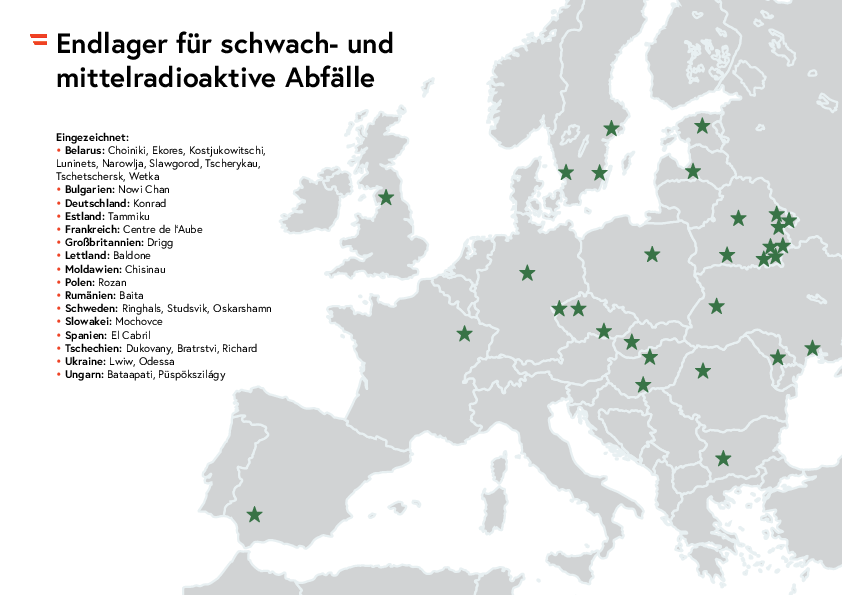
Final disposal of low- and medium-level radioactive waste In some countries, there are already final disposal sites for low- and intermediate-level radioactive waste.
In our neighbouring countries – the Czech Republic, Germany, Slovakia and Hungary – final disposal facilities for low- and intermediate-level radioactive waste have already been built and, in some cases, have come into operation. These facilities are mostly near-surface repositories or underground repositories. In addition, a final repository for low- and intermediate-level radioactive waste is currently under construction in Slovenia. Such facilities are also already in operation or under construction in other European countries, including, for example, France, Spain and Belgium.
The Czech Republic’s first final repository for low- and intermediate-level radioactive waste was built in Hostim in the 1950s, came into operation and was decommissioned in 1997. Three further Czech final disposal facilities are currently in operation: Richard, Bratrství and Dukovany. Whilst the Richard and Bratrství facilities store waste from the medical sector, industry, research and waste containing natural radionuclides, the Dukovany repository is designed to accommodate all low- and intermediate-level radioactive waste from the Temelín and Dukovany nuclear power stations by 2050.
In Germany, too, a repository for low- and intermediate-level radioactive waste is currently under construction: the Konrad mine, a former iron ore mine. Disposal is due to begin in the late 2020s. As early as the 1970s, low- and intermediate-level radioactive waste was stored at the two final repositories, Schacht Asse II and Morsleben. The storage process at Morsleben has now been completed. The repository is now to be decommissioned and securely sealed. The radioactive waste from the Asse mine is being retrieved due to stability issues and is to be disposed of, together with the high-level radioactive waste, in a future deep geological repository.
In Slovakia, the Mochovce final disposal facility for low- and intermediate-level radioactive waste has been in operation since 1999. It is a near-surface repository with concrete tanks, in which low- and intermediate-level radioactive waste from the two nuclear power stations at Bohunice and Mochovce is stored.
Hungary commissioned the near-surface disposal facility at Püspökszilágy in 1976. Low- and intermediate-level radioactive waste was stored there until 2005, when the available capacity was exhausted. Since 2008, the medium-depth geological repository in Bátaapáti has also been in operation for the final disposal of low- and intermediate-level radioactive waste, most of which originates from the Hungarian Paks nuclear power station. The facility consists of large storage chambers excavated in granite rock at a depth of 250 metres beneath a hillside. New findings and operational experience are continuously incorporated into the further development of the final disposal concept.
In 2004, Slovenia initiated the spatial planning and site selection process for the planned repository for low- and intermediate-level radioactive waste. The facility, located in Vrbina in the municipality of Krško, is designed as a near-surface repository with a deep, vertical silo structure. Construction of the repository began in August 2023; trial operation is scheduled for the period 2027–2028. The Slovenian concept for the disposal of low- and intermediate-level radioactive waste represents a hybrid approach that combines key features of both near-surface and geological disposal systems.
The El Cabril final disposal facility project in the province of Córdoba, Spain, was launched in 1986 for the disposal of low- and intermediate-level radioactive waste. The near-surface disposal facility came into operation in 1992. The actual disposal area consists of two platforms with a total of 28 reinforced concrete cells. In 2008, a supplementary facility for very low-level radioactive waste began operation.
The so-called Centre de l’Aube in France, which began operations in 1992, is a near-surface disposal facility for short-lived low- and intermediate-level radioactive waste. It replaced the Centre de La Manche, the first near-surface disposal facility to open in France, which was in operation from 1969 to 1994. The disposal concept is based on a large number of individual concrete chambers (vaults), which are constructed and filled in stages.
Belgium is planning a near-surface repository for short-lived low- and intermediate-level radioactive waste at the Dessel site. Following the granting of a licence in 2023, construction of the facility began in 2025. The final disposal concept is based on the storage of waste, conditioned into monoliths, in concrete chambers (vaults). The long-term containment of the radioactive materials is achieved exclusively through engineered barriers.
The final disposal of high-level radioactive waste and spent nuclear fuel poses major challenges worldwide. As a general rule, a deep geological repository is currently regarded as the ‘state of the art’ for this waste, designed to ensure safe containment for several hundred thousand years. The world’s first final repository for high-level radioactive waste and spent fuel elements was built in Olkiluoto, Finland.