
Radioactive waste in Austria: a survey of the current situation The focus was on collecting and collating relevant information and data on the disposal of radioactive waste.
A detailed understanding of the waste inventory is a fundamental prerequisite for all subsequent steps in the implementation of a final repository project. The volume of waste is a key factor in determining the size of the final repository. The properties of the radioactive waste to be stored are crucial to safety considerations. Since 1976, radioactive waste generated in Austria has been transported to Nuclear Engineering Seibersdorf GmbH (NES) for conditioning and interim storage. The volume of waste generated in Austria is low, particularly when compared with countries that operate nuclear power stations, and is classified as short-lived or long-lived low- and intermediate-level radioactive waste (LILW-SL/LILW-LL).
Austrian Waste Inventory and Trends
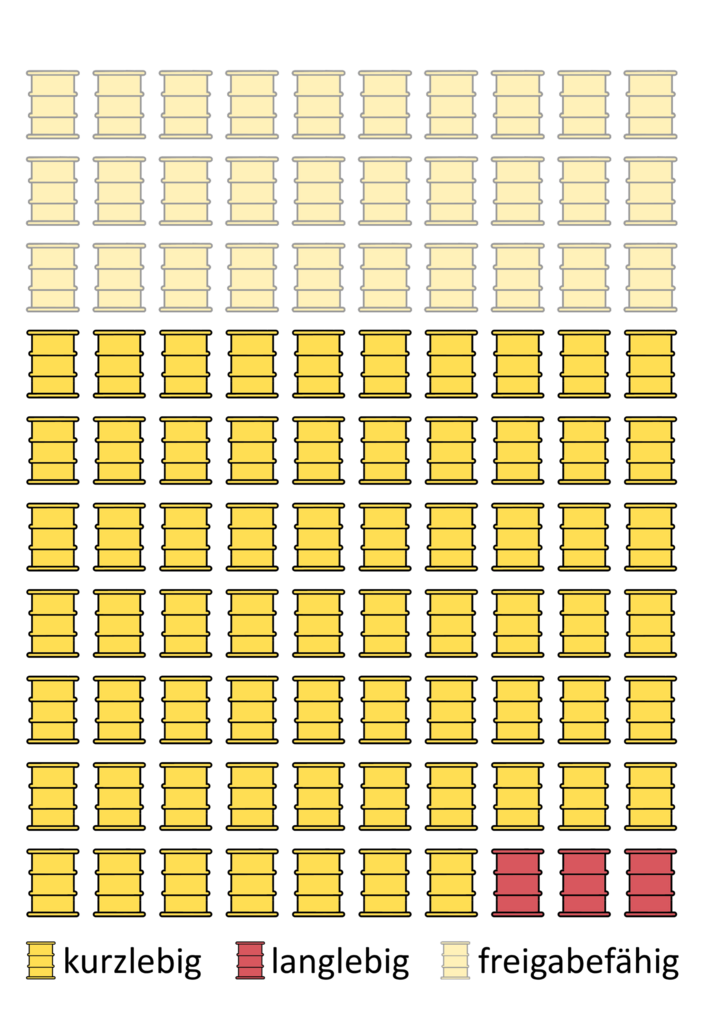
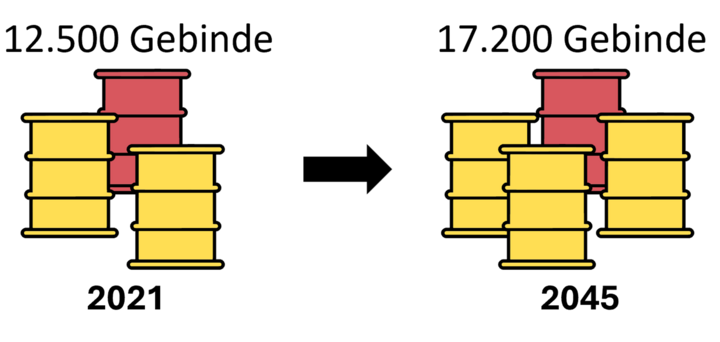
According to the inventory carried out for the Waste Management Advisory Board, as at the end of 2021 there were approximately 12,500 containers (mostly 200-litre drums) at the NES interim storage facility. Based on the number of containers and the classification system used by NES, the total volume amounts to 2,564 m3, divided into LILW-SL (2,512 m3) and LILW-LL (52 m3).
The total activity of the Austrian conditioned waste in the interim storage facility, taking into account the decay behaviour, is 4.03 × 10¹⁵ Bq (as at 2021). This corresponds to around one hundred-thousandth of the total activity of the radioactive waste to be stored in Germany. Within the first 300 years following storage, the activity will decrease to 8.45 × 10¹² Bq. Based on this expected decay behaviour, around 5,000 drums (approximately 30 per cent of the maximum stock forecast for 2045) could be released by 2045.
In the worst-case scenario, 17,200 containers will be generated for final disposal by 2045. This projected number of containers represents a total volume of 3,500 m3. The proportion of LILW-LL is estimated at 100 m3 (less than 3 per cent).
Specific challenges of the Austrian waste inventory
Radium-226 and americium-241 pose a particular challenge for near-surface final disposal in the Austrian inventory of radioactive waste due to their high radiological significance and long-term effects.
A systematic detection strategy, taking into account chemotoxic substances, scenario analyses and inventorying, enables the protection of groundwater and a differentiated assessment of relevant substances.
Release and prevention of waste involving radioactive materials
The prevention and minimisation of radioactive waste is of great importance right from the moment it is generated. As Austria does not operate any nuclear power stations for energy generation, only a comparatively small amount of radioactive waste is produced. Nevertheless, ongoing assessments are carried out to determine how the volume of waste can be further reduced.
A key means of minimising waste lies in the clearance of radioactive materials. Due to the natural decay of radioactive substances, the activity of many waste materials decreases over time. Consequently, once specified clearance levels have been reached, certain materials can be classified as no longer radioactive and subsequently reused or disposed of using conventional methods. This helps to reduce the volume of radioactive waste requiring long-term disposal and to lower the requirements for future final disposal.
Recommendations of the Waste Management Advisory Board
1.1 Waste prevention strategy
Observation: The volume of waste generated in Austria is low – particularly when compared with countries that operate nuclear power stations or other facilities in the nuclear fuel cycle – and is classified exclusively as low- and medium-level radioactive waste. In Austria, there is no spent nuclear fuel or high-level radioactive waste requiring disposal. As the Austrian people voted against the peaceful use of nuclear energy in a referendum and a constitutional law prohibits the use of nuclear power for energy generation, there are still no prospects of such use in the future. One research reactor is currently still in operation; its fuel assemblies are to be returned to the USA without exception.
Recommendation: It must be ensured in future, too, that neither high-level radioactive waste nor spent fuel assemblies are generated in Austria for disposal.
1.2 Release of radioactive materials
Observation: The release of decayed radioactive waste currently in interim storage at NES offers significant potential for waste minimisation (up to 5,000 drums, or approximately 30 per cent of the maximum stock forecast for 2045). This will enable the volume of radioactive waste to be further reduced, financial savings to be realised and the burden on future generations to be minimised.
Recommendation: In the further planning of radioactive waste disposal, the potential for waste minimisation through the release of decayed radioactive materials should be taken into account to the greatest possible extent, and the future project sponsor or Nuclear Engineering Seibersdorf GmbH should be commissioned to examine the feasibility of implementing this release option.