Waste treatment and interim storage by Nuclear Engineering Seibersdorf Nuclear Engineering Seibersdorf (NES) is the only collection point for radioactive waste generated in Austria.
NES’s premises are situated in the municipality of Seibersdorf, approximately 40 km south-east of Vienna, on the site of the local research centre. NES is a wholly-owned subsidiary of the Austrian Institute of Technology (AIT) and has two main tasks, both of which are carried out on behalf of the Republic of Austria:
- The management of all radioactive waste generated in Austria, from collection through to interim storage
- Decommissioning and decontamination of plants, facilities and materials resulting from 45 years of nuclear research and development activities at the Seibersdorf site
Essentially, there are three process stages in waste treatment, which are carried out depending on the type of waste:
- Waste reception to sorting: The waste is received in the NES reception hall. There, the radioactive waste is unloaded from the transport vehicle and an initial characterisation of the waste is carried out. The waste is then sorted and allocated to the appropriate subsequent processing stages.
- Conditioning: Larger, bulky waste, such as contaminated plant or building components, must be dismantled and crushed for conditioning. To minimise the volume of waste, efforts are made to decontaminate contaminated parts, objects or materials as far as possible so that, following clearance testing, they can be returned to the conventional material cycle or sent for landfill. Depending on the type of waste, the following process steps may be considered:
- Incineration of combustible solid and liquid radioactive waste: During this process, the radioactive substances are concentrated in the ash, which is then further conditioned. This achieves a significant reduction in volume, whilst also preventing the materials from reacting.
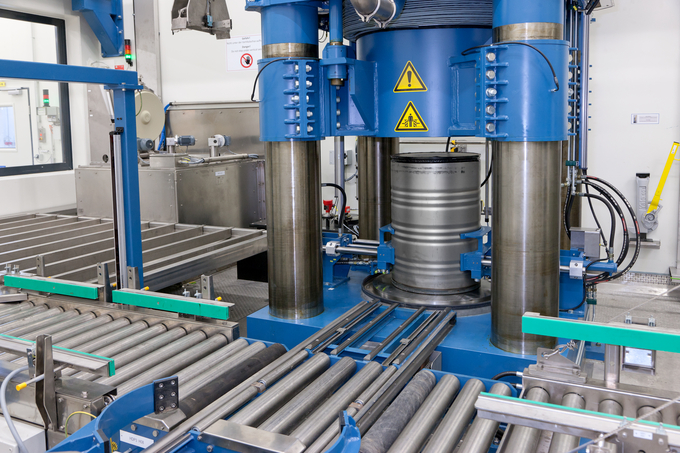
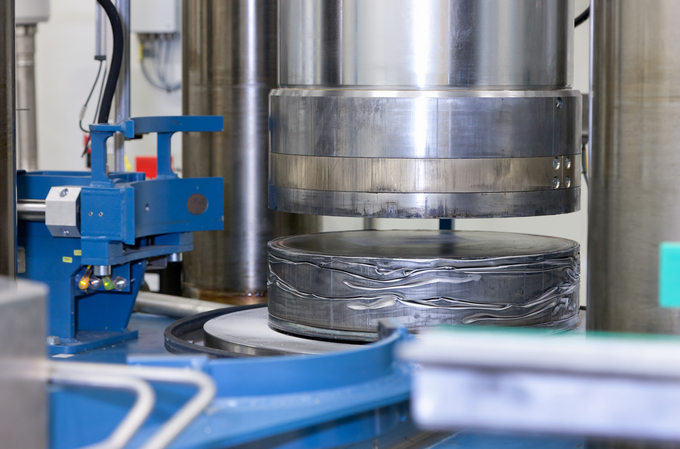
- High-pressure compaction of non-combustible waste: Volume reduction is also achieved here. Furthermore, high-pressure compaction encapsulates the material within a compact matrix, making it impossible to separate the individual components. The compressed pieces are stacked on top of one another in a waste drum.
- In cases where incineration or compaction of the waste is not possible, cementation may be carried out to embed the material in a solid matrix.
- Disused sealed radioactive sources that could not be returned to the manufacturer are removed, documented, sorted by nuclide and, depending on the radionuclide and activity, further processed and conditioned.
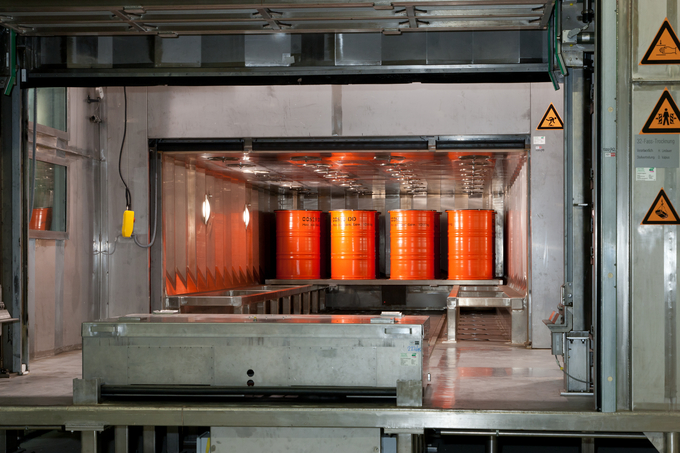
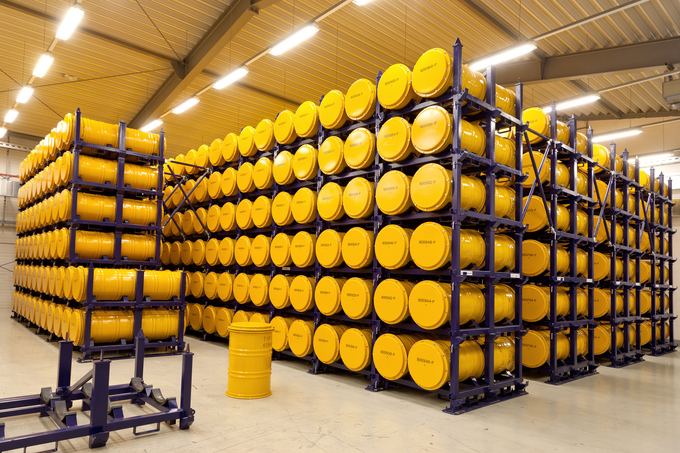
- Drying to interim storage: Fully conditioned waste drums are usually dried in the drum drying plant before being transferred to the climate-controlled interim storage facility (transfer storage). This also chemically stabilises the waste. The waste drums are stored horizontally on steel racks (drum pallets). This ensures they are accessible at all times and can be inspected regularly. All necessary information relating to waste management is documented and stored in a database.
Further information can be found on the Nuclear Engineering Seibersdorf website. This contains detailed descriptions of the various methods and facilities used for waste treatment, as well as further interesting information on this topic.