
Framework conditions for public participation The participation framework comprises four components designed to ensure effective transparency and participation in Austria’s waste management policy.
The safe disposal of radioactive waste requires long-term responsibility and involves complex societal decision-making processes. To build trust and promote sustainable solutions, transparency and the early and ongoing involvement of the public are of paramount importance. Well-structured and professionally facilitated public participation not only strengthens the legitimacy but also the quality of public decision-making processes.
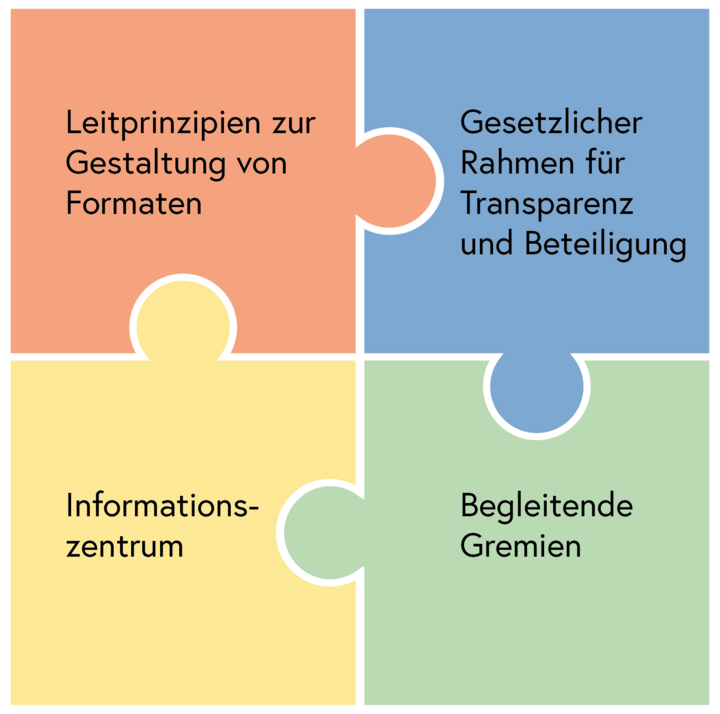
Guiding principles for the design of formats
Public participation essentially describes the involvement of the relevant stakeholders – through information, consultation or cooperation – in the decision-making, planning and implementation of public projects. Transparency and participation should be guiding principles in the management of radioactive waste. The participation processes and their outcomes should be integrated into political and administrative processes.
Newly established frameworks should be guided by the highest standards of transparency and participation.
Legal framework for transparency and participation
Transparency and participation should be enshrined in law in the Final Repository Act and should underpin every stage of the final repository selection process. Key issues such as safety objectives, site criteria and final repository options should be discussed with local authorities and the public at an early stage. The aim is an open and transparent process that enables broad participation and builds trust.
Information Centre
The Information Centre should be established at an early stage as a central hub for transparent information and active opinion-forming, and should continuously support the public throughout all phases of the final repository project and empower them to participate. The information should be made available both digitally and at a physical location.
Supporting bodies
Supporting bodies ensure continuity, provide expert guidance and document the process. The involvement of citizens, and young people in particular, is essential to this.
Recommendations of the Waste Management Advisory Board
3.1 Implementation of the participation strategy
Observation: Public participation is a key factor in ensuring that decisions are accepted. It provides an opportunity to bring diverse experiences and needs to the table. The participation concept sets out how the public is informed and involved in discussions and decision-making. The participation concept provides the basis for further recommendations on transparency and participation at every stage of radioactive waste management.
Recommendation: The participation concept must be implemented in order to ensure effective participation.
3.2 Integrating transparency and participation as guiding principles in political and administrative processes
Observation: Participation is a socially significant and effective communicative and political process. It encompasses providing information, involving people in discussions and decision-making, and taking the results into account. The concept of the policy cycle and the principles of good governance provide a suitable framework as a structuring element and for enhancing the quality of the process. It is important to develop expertise in politics and public administration in the area of ‘participatory planning’.
Recommendation: Participation in the management of radioactive waste must be systematically established and integrated into policy and programme management. Care must be taken to ensure that this task is clearly embedded at an institutional and organisational level and that its quality and effectiveness are assessed in line with the objectives. It is essential to interweave the existing instruments of representative democracy with the participatory procedures proposed in the participation concept.
3.3 Ensuring that transparency and participation are enshrined in law at every stage of the process
Observation: The search for a final repository will require several procedural steps in order to obtain the necessary authorisations (environmental, site, construction,
operation, etc.), with each stage requiring transparency and public participation. At present, this is only provided for in environmental procedures (Strategic Environmental Assessment, Environmental Impact Assessments) and the general legislative review.
Recommendation: Each stage of the process must be conducted transparently and with public participation. The Final Repository Act, as well as the existing legal frameworks applicable to its implementation, should be guided by the highest standards of transparency and public participation (see the Federal Government’s Green Paper ‘Participation in the Digital Age’ and best practice in the implementation of the Aarhus Convention, etc.). In the period prior to the Final Repository Act coming into force, draft proposals – including those on site criteria and the site selection process – are to be drawn up with public participation. These must be adopted as binding and incorporated into the National Waste Management Programme.
3.4 Participation in the selection of site criteria and the site-selection procedure as part of a binding process
Observation: Experience in other countries shows how important it is for the success of the process to establish at an early stage how public participation will be implemented. A well-structured participatory process for the binding establishment of site selection criteria and the procedure for site selection makes it possible to conduct a process without a veto option. The role of local authorities (federal states, cities and municipalities) in site selection has not yet been defined. In Austria, they play a significant role in practice; therefore, they must be involved at various levels in the development of the site selection process.
Recommendation: The public and relevant stakeholders, in particular local authorities, should be invited to participate at an early stage in order to help shape the site selection criteria and the site selection process through a binding, transparent process.
3.5 Early establishment of a ‘coordinating project team’ to ensure the public is structurally involved
Observation: The site selection process and other issues (in particular safety objectives, safety criteria and the type of final repository) should be developed through participatory engagement. To ensure that this participatory process is implemented to a high standard, a ‘coordinating project team’ is required to harmonise the various tasks and coordinate the stakeholders. Oversight by civil society and Parliament should strengthen transparency and democratic legitimacy.
Recommendation: To ensure the effective and sustainable organisation of participatory activities for the development of the site selection process, the Advisory Council on Waste Management recommends the early institutionalisation of a ‘Coordinating Project Team’, which should be directly involved at least until the Final Repository Act comes into force. The project team should be based within the relevant ministry; the relevant specialist departments should be involved. Provision should be made for the participation process to be supported by civil society and Parliament.
3.6 Setting up an information centre
Observation: An information centre serves to provide essential information to enable the public to form their own opinions across various sectors. Such a facility must be provided with resources that are secured in the long term.
Recommendation: An information centre should be established as soon as possible and made available in both a permanent and/or mobile format. It should facilitate the exchange of information throughout all phases of the final repository (design, licensing, construction, operation and post-operation) and provide knowledge in line with the latest scientific and technical developments, tailored to specific target groups and presented in both digital and analogue formats. Responsibility should lie with the administrative unit responsible for supervision (currently the Federal Ministry for Climate Protection, the Environment, Energy, Mobility, Innovation and Technology).
3.7 Establishment of several advisory bodies
Observation: Supporting committees are a key component of participatory processes. They ensure continuity, provide expert guidance and document the process. The involvement of citizens, and young people in particular, is essential to this.
Recommendation: The following committees should be established:
Advisory Committee for Policy and Administration (currently: Waste Management Advisory Board): This advisory committee should be established for as long as there is a need for advice on the management of radioactive waste.
A National Monitoring Committee, acting as a supervisory and documentation body on matters of public participation and process monitoring, should be established before the start of the site selection process.
- Local monitoring committees should be established on a temporary basis in all candidate site regions and on a permanent basis at the final disposal sites, comprising local participants and linked to the other committees.